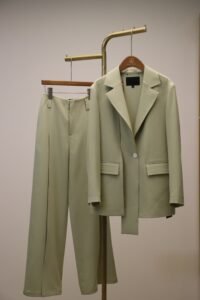
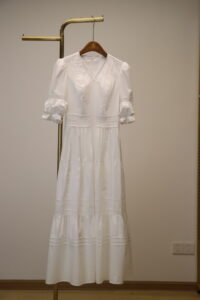
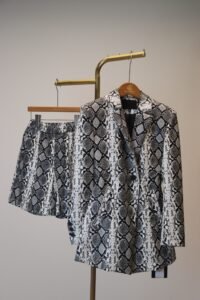
If you run a small fashion brand or dream of launching your own clothing line, you have probably hit one huge roadblock. For decades, clothing manufacturing demanded massive orders, big cash reserves and rigid production plans. Many creative founders gave up on new style ideas simply because they could not afford thousands of pieces at once. Fortunately, low MOQ changes this old rule completely. Low MOQ opens the door for designers on tight budgets, and low MOQ turns creative sketches into sellable products without draining your capital. In fact, low MOQ is the biggest game-changer for independent fashion creators in today’s market.
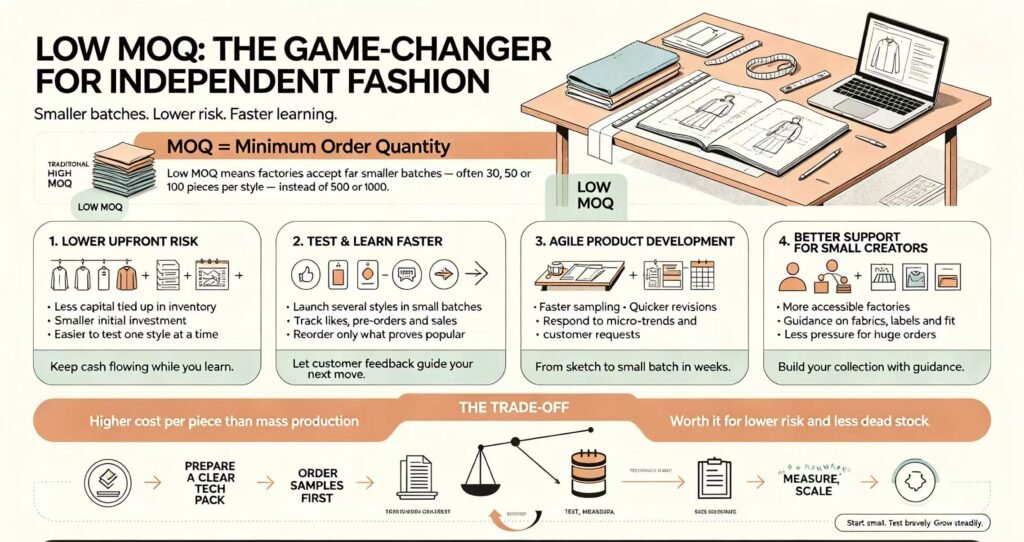
First, let’s clarify what low MOQ really means for fashion startups. MOQ stands for Minimum Order Quantity, and low MOQ means a factory accepts far smaller batch sizes than traditional mass producers. Traditionally, garment factories set high MOQ to cover setup costs for cutting, sewing, labels and fabric preparation. However, modern flexible manufacturers have redesigned their workflows to support low MOQ requests. With low MOQ, you can order 30, 50 or 100 pieces per style instead of 500 or 1000. This matters enormously for small-budget creators, because low MOQ cuts your upfront investment dramatically. When you work with low MOQ suppliers, you do not need to sink money into inventory that might never sell.
Furthermore, low MOQ lets you experiment freely with new styles. Many emerging designers carry multiple creative ideas, yet they hesitate to commit to large runs. If you pick low MOQ production, you can release several new styles in small batches and watch customer feedback closely. For example, you can launch four fresh styles with low MOQ, track which ones get likes, pre-orders and sales, then reorder the popular designs later. On the contrary, high MOQ forces you to bet everything on one or two styles, and one flop can sink your small budget. Because low MOQ reduces financial risk, you can lean into bolder cuts, unique prints and niche aesthetics you love. This is exactly why low MOQ has become the go-to choice for capsule collections and seasonal micro-drops.
In addition to testing new styles safely, low MOQ speeds up your product development cycle. Large factories with high MOQ usually have long lead times, packed schedules and slow sample approvals. Comparatively, suppliers specialised in low MOQ are built for agility. Once your tech pack is ready, a low MOQ partner can finish sampling and small-batch production in weeks. As a result, you can respond faster to micro-trends and customer requests. If your audience asks for a colour tweak or a revised fit, low MOQ makes it practical to adjust and run another tiny batch. Without low MOQ, fast iteration would be impossible for brands working on small budgets.
You might still wonder about the downside of low MOQ. It is true that per-unit costs for low MOQ are often higher than mass production. Even so, most small brand owners agree this trade-off is worthwhile. Why? Because low MOQ eliminates dead stock risk. Dead stock is one of the costliest pain points in fashion; unsold garments lock up cash and take up storage space. When you use low MOQ, you only manufacture what you reasonably expect to move. Besides that, you can scale gradually. After a low MOQ style proves profitable, you can place a larger follow-up order to bring the unit price down. In this way, low MOQ acts as your low-risk bridge from idea to scalable fashion business.
Another overlooked advantage of low MOQ is better supplier communication for small creators. Big factories prioritise huge orders, so small buyers often get slow replies and low priority. By contrast, factories focused on low MOQ are set up to serve small brands. They are more willing to walk you through fabric swatches, fit revisions, custom labels and packaging details. For new designers who are still learning the sourcing process, this level of support is priceless. With low MOQ support, you do not need a huge team or years of industry connections to release polished, original new styles.
So how can you make the most of low MOQ for your small-budget collection? Start by preparing a clear tech pack for every new style you want to test. Next, shortlist verified suppliers that explicitly advertise low MOQ for custom cut-and-sew. Then, order one or two samples first to confirm fabric quality, stitching and fit before locking your low MOQ bulk order. After you receive the low MOQ batch, gather honest feedback from buyers and social followers. Finally, double down on winning styles and archive the ones that underperform. This simple loop works perfectly because low MOQ keeps every step affordable and reversible.
Many successful independent fashion brands started exactly this way. They did not begin with big investor money or warehouse-sized inventory. Instead, they used low MOQ to roll out one small collection after another, refining their aesthetic slowly. Over time, their loyal customer base grew alongside their product range. Without low MOQ, most of these inspiring brands would never have launched their first new style at all. Low MOQ does not just reduce order sizes; low MOQ democratises fashion creation for anyone with a creative vision and a modest budget.
Final Thoughts
Gone are the days when only well-funded labels could launch original new styles. Low MOQ breaks the old financial barrier and puts garment production within reach of solopreneurs, hobby designers and side-hustle fashion builders. If you have been holding back your design ideas because you worry about budget and unsold stock, low MOQ is the solution you have been searching for. Start small, test bravely, learn from sales data, and grow steadily. Low MOQ makes creative fashion entrepreneurship accessible for everyone.