Skip to content
If you run a women’s fashion brand, one of the most critical sourcing decisions you will face is picking between OEM and ODM for women’s fashion. Many new founders confuse the two models, and choosing incorrectly can lead to wasted budget, slow launches, generic products, or missed brand positioning goals. In this guide, we break down OEM vs ODM for women’s fashion clearly, walk through their pros and cons, and help you settle on the production route aligned with your brand vision.
First, let’s define the core terms so you can evaluate OEM vs ODM for women’s fashion without industry jargon clouding your judgment.
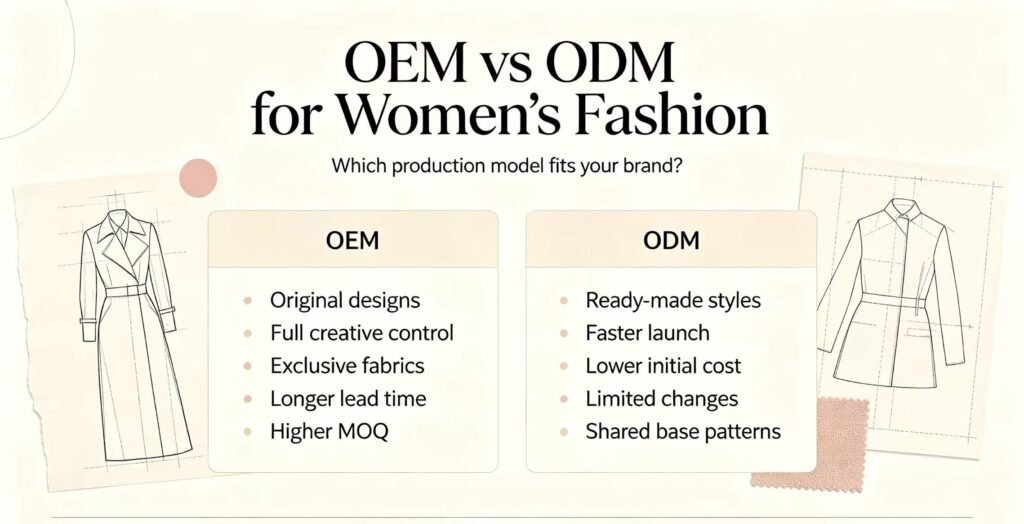
OEM stands for Original Equipment Manufacturer. In OEM cooperation, your brand owns all design work. You supply tech packs, sketches, fabric specifications, grading rules and fit standards, and the factory only executes production following your exact brief. When you select OEM for women’s fashion, you hold full creative control of every garment silhouette, stitching detail, and material choice.
On the other side, ODM means Original Design Manufacturer. For ODM partnerships, the factory develops ready-made women’s apparel styles in-house. You select existing designs from their catalog and make limited adjustments such as fabric swap, color updates, label printing, and minor length tweaks. Understanding this core divide makes it far easier to weigh OEM vs ODM for women’s fashion for your upcoming collection launch.
Now let’s explore the major advantages of choosing OEM for women’s fashion.
Above all, OEM delivers maximum product uniqueness. If you aim to build a premium women’s fashion brand with signature styles that cannot be easily replicated, OEM is your strongest foundation. Additionally, OEM allows complete intellectual property ownership of your designs. Unlike ODM, factories cannot sell the same base pattern to competing brands once you develop styles via OEM. Moreover, OEM supports unlimited customization: custom necklines, exclusive fabric blends, tailored sizing curves, and bespoke embellishments are all achievable. For long-term brand loyalty, distinct products built through OEM help your store stand out amid crowded women’s fashion markets.
Even so, OEM for women’s fashion carries clear downsides to consider when comparing OEM vs ODM for women’s fashion. OEM requires longer lead times. You must complete design drafting, pattern making, sample revision, and fabric sourcing before bulk production starts. This extended timeline is risky if you need to capture fast fashion trends. Next, OEM usually demands higher minimum order quantities and higher upfront sampling costs. You need an in-house designer or professional tech pack creator to prepare all production documents. Without proper design resources, you will struggle to manage OEM workflows smoothly.
Moving forward, let’s review the benefits of selecting ODM for women’s fashion.
The biggest strength of ODM is speed to market. Since all base patterns and sample development work belong to the factory, you skip the lengthy design phase required by OEM. If you are launching a startup women’s fashion label or testing new product categories, ODM lets you roll out collections in weeks instead of months. Furthermore, ODM lowers initial investment. Sampling fees, development charges and MOQs are generally much lower than OEM. This makes ODM ideal for brands with limited startup capital. You also avoid the pressure of maintaining a full design team, as the factory’s design studio handles trend research and style development. When you want to test consumer demand without heavy risk, ODM becomes a practical option as you compare OEM vs ODM for women’s fashion.
Nevertheless, ODM for women’s fashion has notable limitations that cannot be ignored. Most importantly, core design rights remain with the manufacturer. The factory can sell identical base styles to other women’s fashion brands, which means you risk facing direct competitors with near-identical garments. Customization boundaries also exist under ODM: radical silhouette changes, complex structural adjustments or exclusive fabric development are often not supported. If you plan to build a luxury brand built on one-of-a-kind pieces, relying purely on ODM will restrict your growth potential.
So how do you know which option wins when you compare OEM vs ODM for women’s fashion? We have prepared simple decision criteria you can apply directly.
Choose OEM for women’s fashion if:
- You have finalized original designs and complete tech packs
- Brand differentiation and exclusive product lines are your top priority
- You target premium, mid-to-high-end women’s fashion positioning
- You have stable order volume and can accommodate longer production lead times
- You want full ownership and legal protection of all garment designs
Choose ODM for women’s fashion if:
- You are a new brand launching your first women’s fashion collection
- You lack design staff or the budget to create styles from scratch
- You need fast turnaround to follow seasonal trends
- You want to test market reaction to new styles with smaller order quantities
- You focus on accessible, mass-market women’s apparel and do not require fully exclusive silhouettes
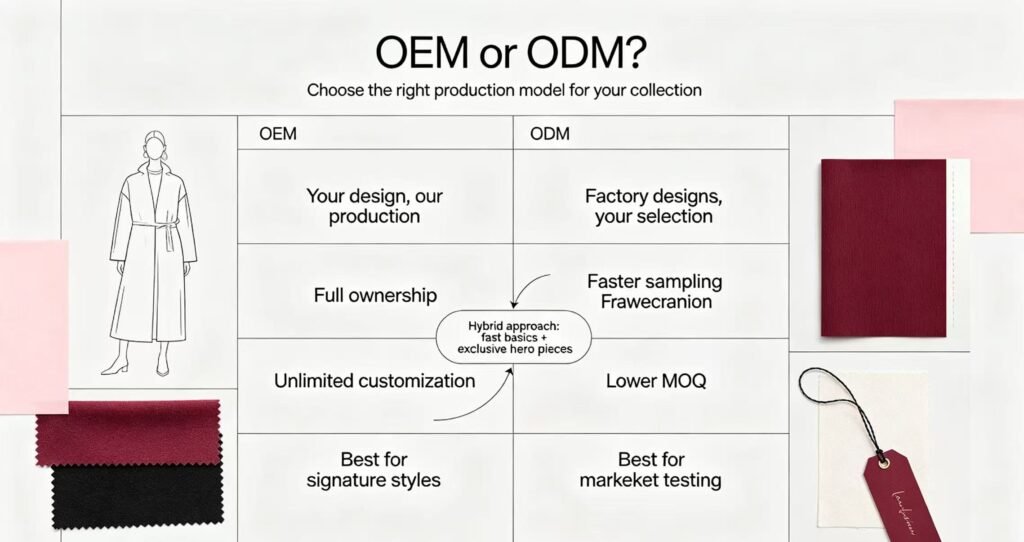
It is worth noting that many successful women’s fashion brands adopt a hybrid strategy after analyzing OEM vs ODM for women’s fashion. They use ODM to quickly launch trendy basic items to generate cash flow, while investing in OEM to develop signature hero styles that define brand identity. This balanced approach balances speed, cost control and product uniqueness.
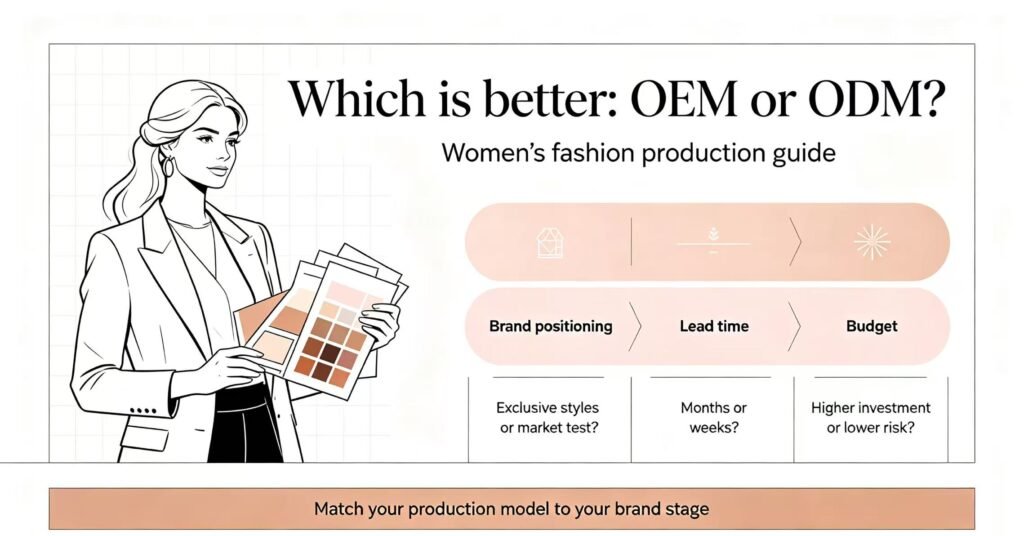
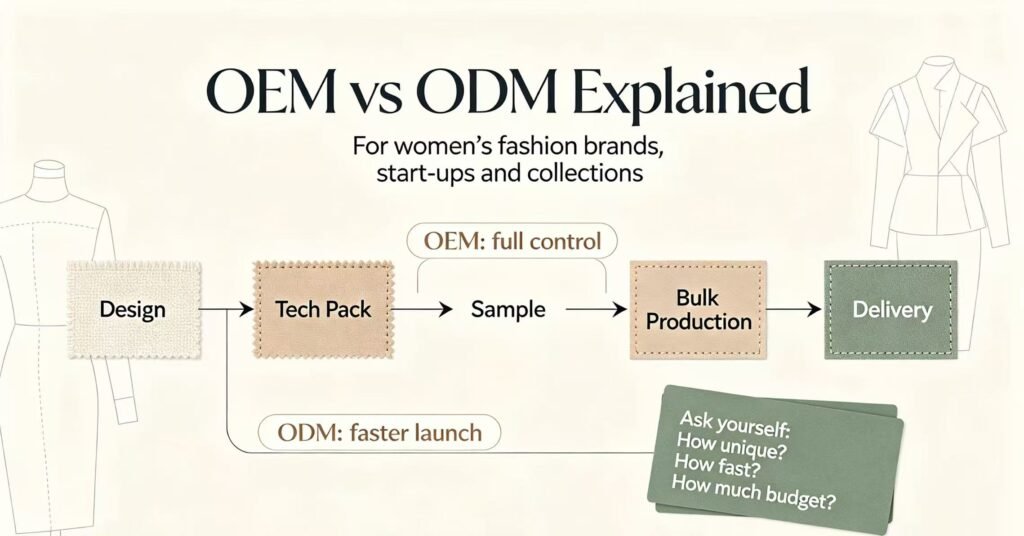
Before you contact apparel manufacturers, complete one final self-check to confirm your choice between OEM vs ODM for women’s fashion. Ask yourself three simple questions: How unique must my women’s clothing be? What lead time can my sales timeline accept? What total budget can I allocate to sampling and development? Your honest answers will eliminate much uncertainty when negotiating with factories.
To wrap up, there is no universal “better” side between OEM vs ODM for women’s fashion. OEM unlocks creative freedom and exclusive designs for established, premium brands. ODM delivers agility and low risk for emerging labels testing market fit. Match your production model to your brand stage, budget and long-term goals, and you will avoid costly sourcing mistakes in your women’s fashion supply chain.
Once you decide whether OEM or ODM fits your roadmap, you can start sourcing reliable women’s apparel manufacturers who fully understand your chosen production model and support your collection growth.