Skip to content
If you’re in the garment export business, few things will sink a shipment faster than an incorrect customs declaration. One of the most commonly misclassified product categories in international trade is women’s apparel — specifically dresses and skirts made from woven fabrics. In this guide, we’ll walk you through exactly how to determine the correct HS code for woven dress and skirt export, why Chapter 62 matters, how fiber content changes your duty rate, and the costly mistakes you should avoid when declaring the HS code for woven dress and skirt export on your commercial invoices and packing lists.
Why Getting the HS Code for Woven Dress and Skirt Export Right Matters
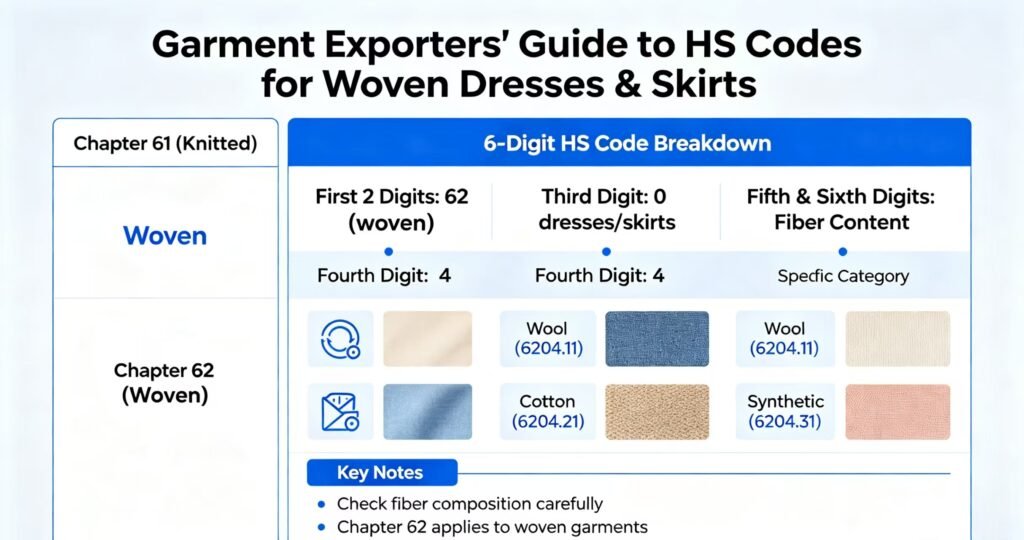
First and foremost, customs authorities in the US, EU, UK, Canada, and Australia rely heavily on Harmonized System (HS) codes to assess import duties, enforce quotas, and verify rules of origin. If you declare the wrong HS code for woven dress and skirt export, you risk shipment holds, unexpected anti-dumping duties, denied preferential tariff treatment under FTAs, and even fines for misclassification. That’s why understanding the correct HS code for woven dress and skirt export is not just a paperwork task — it’s a core part of your margin protection strategy.
Chapter 61 vs. Chapter 62: The First Big Decision for HS Code for Woven Dress and Skirt Export
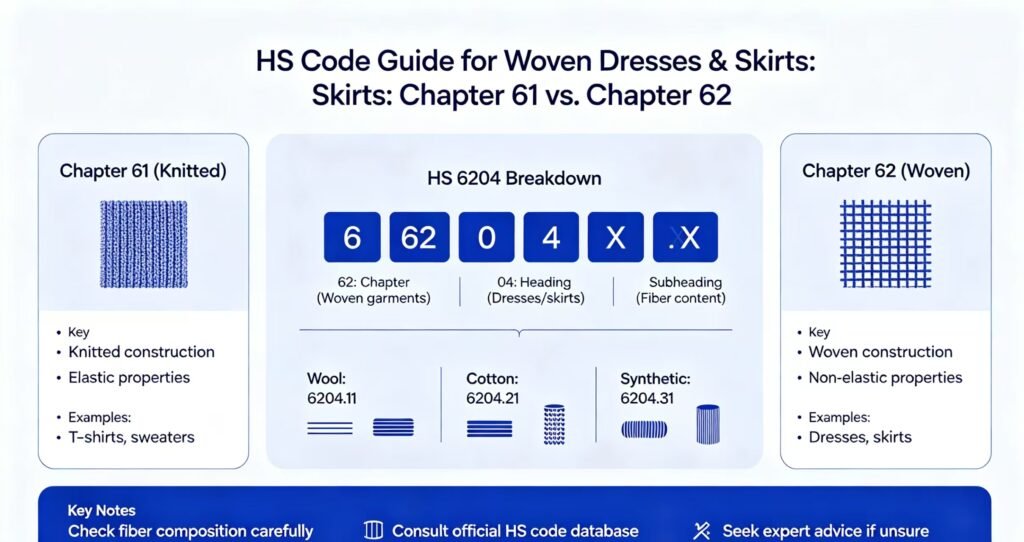
The very first step in finding the correct HS code for woven dress and skirt export is identifying whether the garment is knitted/crochetedor woven (not knitted or crocheted).
- Chapter 61 = knitted or crocheted apparel → women’s knitted dresses and skirts fall under HS heading 6104.
- Chapter 62 = woven (non-knitted) apparel → women’s or girls’ woven dresses and skirts fall under HS heading 6204.
Because we are focusing on woven garments, the proper HS code for woven dress and skirt export will always begin with 6204, which is the heading for “women’s or girls’ suits, ensembles, jackets, blazers, dresses, skirts, divided skirts, trousers, bib and brace overalls, breeches and shorts (not knitted or crocheted).” Therefore, every correct HS code for woven dress and skirt export in our context uses 6204 as the foundation.
Breaking Down the 6-Digit HS Code for Woven Dress and Skirt Export
Once you’ve confirmed the garment is woven and intended for women or girls, you’ll break the HS code for woven dress and skirt export down to the 6-digit level as follows:
For Woven Dresses (Women’s / Girls’):
- 6204.41 — Of wool or fine animal hair (one valid HS code for woven dress and skirt export when wool predominates)
- 6204.42 — Of cotton (the most common HS code for woven dress and skirt export with 100% or majority cotton woven fabric)
- 6204.43 — Of synthetic fibers (e.g., polyester, nylon) (another typical HS code for woven dress and skirt export)
- 6204.44 — Of artificial fibers (e.g., viscose/rayon)
- 6204.49 — Of other textile materials (e.g., silk, linen, ramie, or blends where none of the above predominates) (frequently used HS code for woven dress and skirt export for luxury or specialty fabrics)
For Woven Skirts & Divided Skirts (Women’s / Girls’):
- 6204.51 — Of wool or fine animal hair
- 6204.52 — Of cotton (standard HS code for woven dress and skirt export when classifying a cotton woven skirt)
- 6204.53 — Of synthetic fibers
- 6204.59 — Of other textile materials (HS code for woven dress and skirt export applied to silk, linen, or other fiber skirts)
Each of these subheadings represents a legally recognized HS code for woven dress and skirt export, and the difference in those last two digits can mean a 5% to 28% variance in Most Favored Nation (MFN) duty rates depending on the destination country.
How Fabric Composition Affects the HS Code for Woven Dress and Skirt Export
In practice, many garments today are blends. When assigning the HS code for woven dress and skirt export on a blended fabric, customs rules state you must classify based on the fiber that constitutes the greatest percentage by weight. For example:
- A woven dress that is 60% cotton / 40% polyester → the correct HS code for woven dress and skirt export is 6204.42.
- A woven skirt that is 55% polyester / 45% cotton → the correct HS code for woven dress and skirt export is 6204.53.
If fibers are equal in weight and no single one predominates, refer to the last heading in numerical orderamong those equally represented — but this is rare and should be confirmed with your customs broker before finalizing the HS code for woven dress and skirt export.
Special Cases That Change the HS Code for Woven Dress and Skirt Export
There are a few scenarios where the standard 6204 HS code for woven dress and skirt export does notapply:
- Ensembles / Suits: If the dress or skirt is part of a matching woven suit sold with a jacket of the same fabric and style, it may be classified under 6204.11–6204.19 (suits) rather than the standalone HS code for woven dress and skirt export.
- Culottes / Divided Skirts: Still classified under 6204.5x — so your HS code for woven dress and skirt export remains in heading 6204.
- Knitted Jersey Dresses: These are nota valid HS code for woven dress and skirt export — they belong in Chapter 61 (6104).
- Swimwear / Sleepwear: Excluded from 6204; these have their own headings and never use the HS code for woven dress and skirt export.
Common Mistakes Exporters Make With HS Code for Woven Dress and Skirt Export
Even experienced shippers get tripped up. Here are the top errors to avoid when declaring the HS code for woven dress and skirt export:
- Confusing knit with woven — Using 6104 instead of the correct HS code for woven dress and skirt export under 6204 leads to wrong duty rates and possible penalties.
- Guessing fiber content — Always request a lab-dip or full composition statement from the factory before locking in the HS code for woven dress and skirt export.
- Using only 4 digits — Many countries require 6, 8, or 10-digit national tariff codes. The base HS code for woven dress and skirt export (6-digit) is internationally harmonized, but you must append local digits for the destination market.
- Ignoring country of origin marking — Some markets (e.g., USA CBP) tie the validity of your HS code for woven dress and skirt export to correct country-of-origin labels.
Quick Reference Table: HS Code for Woven Dress and Skirt Export (Women’s / Girls’)
| Garment | Fabric | 6-Digit HS Code for Woven Dress and Skirt Export |
|---|---|---|
| Dress | Wool | 6204.41 |
| Dress | Cotton | 6204.42 |
| Dress | Synthetic | 6204.43 |
| Dress | Other (silk/linen) | 6204.49 |
| Skirt | Wool | 6204.51 |
| Skirt | Cotton | 6204.52 |
| Skirt | Synthetic | 6204.53 |
| Skirt | Other (silk/linen) | 6204.59 |
Bookmark this table so your team always picks the correct HS code for woven dress and skirt export before preparing shipping documents.
Final Takeaway on HS Code for Woven Dress and Skirt Export
To summarize, the universally accepted first step for women’s or girls’ woven dresses and skirts is heading 6204 under Chapter 62. From there, fiber content determines the exact HS code for woven dress and skirt export you should declare. Double-check knit vs. woven, confirm the predominant fiber, watch out for suit ensembles, and align with your destination country’s digit requirements. Doing so protects your shipments from customs delays and ensures you pay the correct duty — not a penny more. When in doubt, consult a licensed customs broker before finalizing the HS code for woven dress and skirt export on your export declaration.