Skip to content
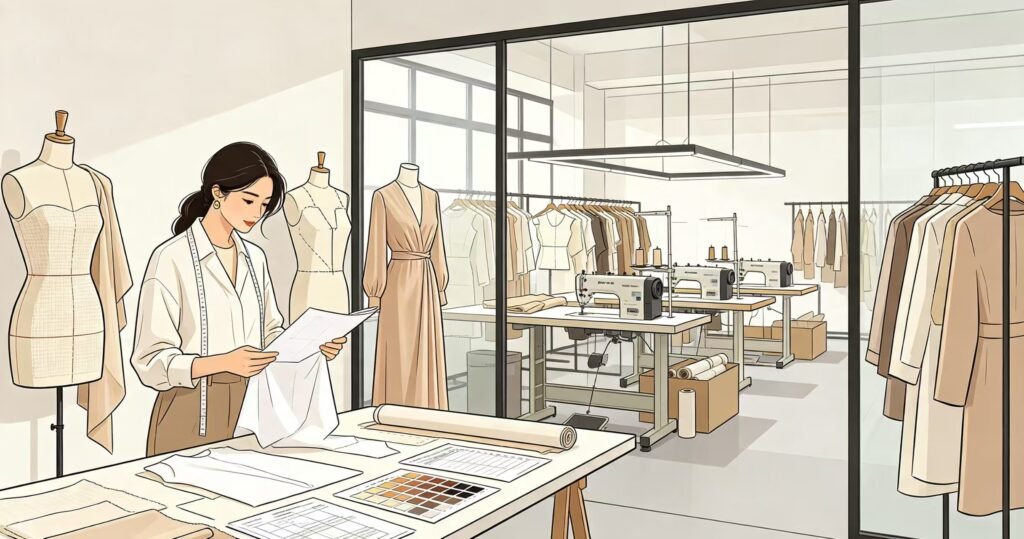
Launching a designer women’s label in 2026 feels nothing like it did ten years ago. Back then, you either committed to 1,000 pieces per style or you stayed a hobbyist. Today, the smartest independent founders skip the warehouse gamble entirely and build their first drops with small batch clothing manufacturers who treat a 60-piece run with the same seriousness as a 6,000-piece order.
This shift isn’t a fad. It’s a structural change in how fashion supply chains work — especially for boutique womenswear, modest wear, and Kuala Lumpur’s rising studio labels.
Why Designer Women’s Wear Demands a Flexible Sourcing Model
Designer pieces live or die on fit, drape, and fabric hand-feel. A muslin prototype that looks perfect on a croquis can collapse in acetate. That’s why more founders now anchor their early collections with small batch clothing manufacturers instead of chasing the cheapest bulk quote.
When your run is 50–300 pieces per style, you can:
- Test two neckline variations in the same season
- Swap a polyester lining for Tencel after one round of feedback
- Catch a grading error before it becomes 800 returned dresses
In short, flexibility is not a luxury — it’s the margin of safety for any label that cares about design integrity.
What “Small Run” Actually Means in Womenswear
People hear “small batch” and imagine tiny artisan studios. In reality, the best small batch clothing manufacturers are mid-sized OEM/ODM factories in Guangdong, Zhejiang, or Istanbul that simply opened a low-MOQ lane.
Typical numbers you’ll see:
- MOQ: 30–100 pcs/style for knits, 50–150 pcs/style for woven
- Sampling: 7–12 working days with a digital tech pack
- Reorder window: 18–30 days air, 35–45 days sea
That cadence fits a Malaysian designer dropping a Raya capsule in October, then flipping to a resort line in February — without drowning in deadstock.
The Malaysia Modest-Wear Angle
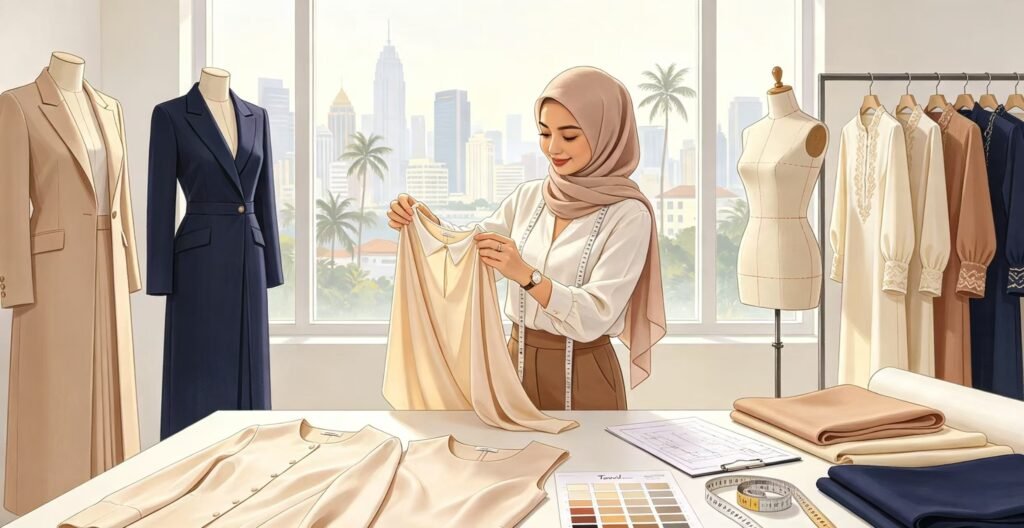
Kuala Lumpur’s modest fashion scene (Baju Kurung updates, longline blazers, wudu’-friendly sleeves) has zero tolerance for itchy linings or see-through double-georgette. Brands like Anaabu, Kanoe, and Whimsigirl grew precisely because they refused cookie-cutter mass production.
Working with small batch clothing manufacturers lets a KL founder:
- Specify 120gsm acetate instead of 90gsm poly-blend
- Request bilingual (BM + EN) care labels from day one
- Prototype a sleeve that rolls past the wrist but doesn’t bag at the elbow
More importantly, it keeps the designer in the driver’s seat. The factory executes; the studio owns the silhouette.
How to Brief a Factory Without Wasting the First Sample
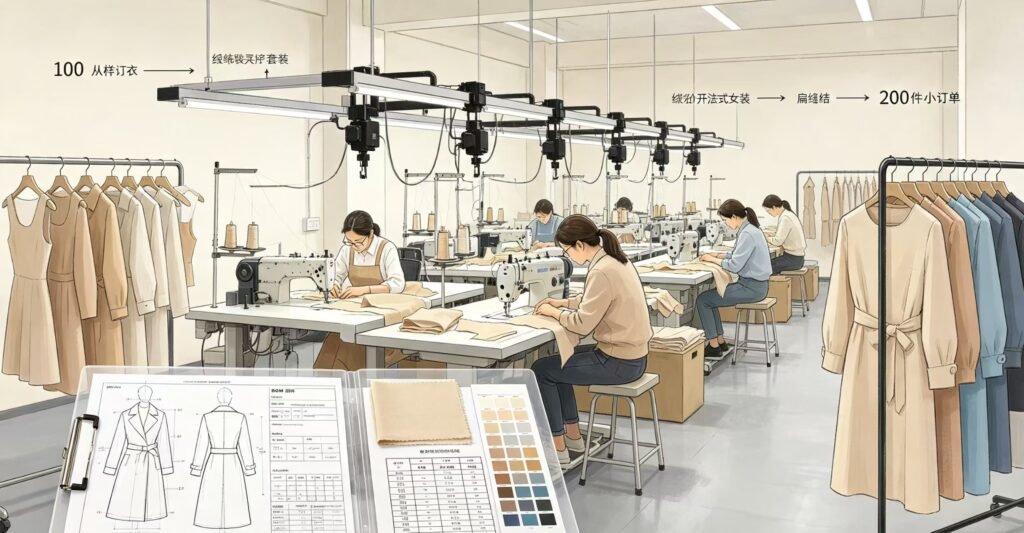
Western buyers often ask for “a quote” before they’ve drawn a thing. That’s backwards. The factories worth your time — the small batch clothing manufacturers who survive on boutique accounts — want a clean tech pack:
- Flat sketch (front/back/side)
- BOM: fabric composition, GSM, trim source
- Measurement spec with tolerance
- Construction notes (flatlock? French seam? bar tack?)
- Colorways in Pantone TCX
Send that, and your first sample comes back close. Skip it, and you’ll burn three weeks arguing about whether “oatmeal” meant #13-0905 or #11-0105.
Avoiding the Low-MOQ Trap
Not every shop advertising “low MOQ” deserves the call. Some large bulk plants accept 80-piece orders then queue you behind a 40,000-piece order from a supermarket brand. Your delivery slips, your embroidery gets rushed, and suddenly “flexible” means “flexible for them.”
The small batch clothing manufacturers you want will:
- Show you a WhatsApp video of your own line running
- Offer AQL 2.5 inspection as default, not upsell
- Talk about shrinkage and seam slippage unprompted
- Have OEKO-TEX or SMETA, even if they don’t shout about it
If a factory can’t explain how they protect a small run from being deprioritized, walk.
Sourcing Closer to Home vs. Asia
For a Malaysian label, “local production” sounds romantic. In practice, a KL tailor-house charges RM70–120 per finishing hour and caps you at 30 pieces a week. Great for bridal, terrible for a 200-piece Raya restock.
That’s why many SEA founders split the map:
- Pattern + first sample: local studio (fast feedback loop)
- Bulk of 100–300 pcs/style: small batch clothing manufacturers in China/Vietnam with export docs to Port Klang
- Top-up reorders: same Asian partner, 3-week air turnaround
You keep creative control in KL, and you keep unit economics sane.
A Simple 4-Step Sourcing Flow
Step 1 – Lock the capsule. Three to five styles, two colorways each. Don’t launch nine.
Step 2 – Build the tech pack. Even a Notion doc with scans beats a Instagram screenshot.
Step 3 – Shortlist three partners. Among the small batch clothing manufacturers you screen, reject anyone who won’t share a past women’s wear client reference.
Step 4 – Sample, wear-test, reorder. Wear the proto on a Grab ride, under KL humidity, through one laundry cycle. Then approve.
What Good Looks Like in 2026
The brands winning right now aren’t the ones with the biggest opening order. They’re the ones whose small batch clothing manufacturers let them:
- Drop a 120-piece run, sell 90, tweak the waist, reorder 140
- Tell customers “this lining is GOTS cotton” and mean it
- Survive a trend miss without a container of regret sitting in Subang
Flexibility, in other words, is the new moat.
Closing Note for Founders Knocking on Factory Doors
If you’re a designer walking into a Guangzhou office or DMing a sourcing manager on LinkedIn, lead with the work — not the dream. Say: “I have a 4-style modest capsule, MOQ target 100/style, acetate and Tencel only, bilingual labels, Raya timing.” That sentence filters out 80% of wrong factories and puts you in front of the small batch clothing manufacturers who’ll actually reply.
Small runs aren’t small thinking. They’re how modern women’s wear gets born — one tested sample, one honest reorder, one collection at a time.