Skip to content

You did not start a label so you could spend four days a week chasing fabric, re-checking a measurement sheet and explaining a customs delay to a stockist. Yet that is what the first two years of most independent brands look like.
There is a simpler arrangement. Hand sampling, production, quality control and shipping to a single clothing manufacturer — one schedule, one contact, one set of documents — then go back to the part that actually pays: selling.
Elisun Garment is a Guangzhou-based clothing manufacturer founded in 2019. The team is more than 100 people strong, produces 35,000 to 40,000 pieces a month, and has spent seven years making high-end dresses, outerwear, men’s vests, shirts and blouses for European labels.
What a clothing manufacturer should take off your desk
Every supplier says they offer a full service. Far fewer will put on paper which handoffs they are willing to take off your desk. Here is ours, stage by stage.
| Stage | What usually lands on your desk | What lands on ours |
| Sampling | Briefing three sampling studios, arguing about a pattern fee, then waiting on a fit that still looks wrong | Pattern making, sample sewing, fit corrections, measurement sheet and photographs |
| Production | Chasing a factory calendar and hoping your slot still exists next month | Fabric inspection, cutting, sewing, pressing and in-line tracking |
| Quality control | Booking an inspection agency, then interpreting a report nobody explains | Fabric checks on arrival, in-process checks, final inspection, trimming and packing |
| Shipping | Carton marks, packing list, export documents and forwarder e-mails | Carton marking, packing against your list, export paperwork, ready-shipment staging and handover |
Read the right-hand column again. None of it is creative work. It is admin, chasing and follow-up — exactly the work a clothing manufacturer should be doing on your behalf, and exactly the work that keeps an owner out of the studio.
Step one — sampling, where a clothing manufacturer gets judged
In practice, the sample is the whole relationship in miniature. When it arrives late, fits badly or quietly changes a detail from your tech pack, nothing that follows feels safe.
Sampling here takes 7 to 14 days when the fabric is in stock, and a simple style in a stock material can be turned around in 7 days. The sample room sits beside the pattern room, so a correction does not travel through three inboxes before someone touches the garment.
What comes back is not only a garment. You get the pattern, a fit sample, a measurement sheet and clear photographs — enough to comment, re-cut and approve without another round of guesswork.
However, speed only counts when it repeats. A clothing manufacturer that rushes the first sample and cannot reproduce it at scale has sold you a prototype, not a product. For that reason, the people who sew your sample are the people who set up your bulk order.
Step two — production on a calendar the clothing manufacturer controls
Bulk production for a fashion style runs about 35 days. With more than 100 workers and 35,000 to 40,000 pieces per month of capacity, there is room for a repeat order without pushing your first delivery out of the window.
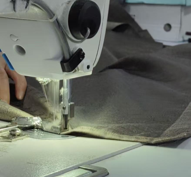
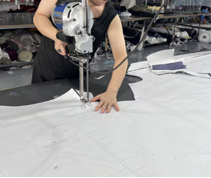
Inside those 35 days the work splits into stages you can audit: fabric inspection and storage, spreading and cutting, sewing lines for overlock, flat sewing and pleating, under-pressing and final pressing, then finishing.
Meanwhile, small runs stay welcome. The minimum is 100 pieces per style, and a smaller trial batch is a conversation rather than a refusal — which matters more than it sounds when you are testing a new silhouette.
A clothing manufacturer with a fixed calendar can also decline a late change instead of absorbing it silently and paying for it with your delivery date.
Step three — quality control at three gates, not one
Most quality problems are cheap to fix early and impossible to fix late. So inspection happens three times, at three different points in the line.
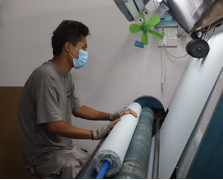
- Fabric gate — shade, weight, hand-feel and visible defects are checked when the roll arrives, before it is released to cutting.
- In-process gate — measurements, construction and stitch quality are checked while the order is still on the line, so a bad seam is 20 pieces instead of 2,000.
- Final gate — every order is inspected before packing, with buttons attached by hand and threads trimmed, so nothing leaves with a loose end.
After delivery the order carries a 6-month quality warranty. Claims are answered within 24 hours, and the fix is a rework, a return or a discount — whichever actually solves the problem rather than the paperwork.
To be fair, no clothing manufacturer inspects itself into perfection, and on a first order you should still book your own third-party inspection if that helps you sleep. Ours runs either way.
Step four — shipping, where most clothing manufacturers go quiet
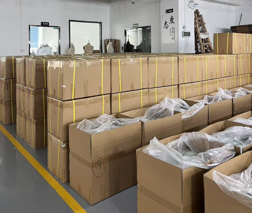
That said, the last mile is where good factories lose their voice. Cartons get marked late, the packing list does not match the invoice, and your forwarder starts asking questions that nobody can answer.
Here the goods leave from Guangzhou, where the office and the factory share one address. Cartons are marked and packed against your packing list, export documents are prepared and checked before the container is booked, and finished goods wait in a ready-shipment area instead of being scattered across the floor.
You can keep your own forwarder — most clients do. The point is that you are not the one assembling documents at midnight before a vessel cut-off.
A clothing manufacturer that owns the cartons and the paperwork removes the last excuse in the chain, and with it the last late-night phone call.
Compliance a clothing manufacturer has to prove
Certificates do not make a garment good, but they open doors. This clothing manufacturer works to BSCI, GRS and OEKO-TEX STANDARD 100, and fabric and accessory development is built into the service instead of being sold back as an upgrade.
On top of that, the range is deliberately narrow: high-end dresses, outerwear, men’s vests, shirts, blouses and skirts, plus evening dress customisation. A focused clothing manufacturer gets better at a category instead of claiming to master all of them.
Seven questions to ask any clothing manufacturer
- Who owns the pattern, and do I get a copy at the end?
- How long is sampling with my fabric, rather than with yours?
- What is the genuine bulk lead time after sample approval?
- Where does inspection happen, and will I see the report?
- Is the minimum order per style or per colour?
- Who prepares the export documents, and who checks them?
- What happens, in writing, if the goods arrive wrong?
Ask these before you discuss price. A clothing manufacturer that answers slowly will also answer your e-mails slowly.
Three red flags in a clothing manufacturer
- The sample is perfect and the bulk is a different garment. That usually means the sample was bought in rather than made in-house.
- Every question comes back as “no problem”. A partner who never says no is not protecting your delivery date.
- Nobody can name the person who signs off final inspection.
A clothing manufacturer is only as good as its worst order, so judge the orders it will not discuss.
Process only counts when an order tests it
Two recent orders explain more than any capability list.
A schoolwear brand came to us after their previous supplier leaked their designs. They had no tech pack — only hand-drawn sketches. We turned the sketches into visual renderings first, so they could approve a look before paying for a sample. They also had to accept a higher price than their old low-cost supplier; what closed that gap was student-safe eco materials and a partner they could hold accountable. The first batch sold out at schools across Kazakhstan, and repeat orders now arrive before each semester.
Around the same time, two designers from Cyprus walked into TEXWORLD with hand-drafted patterns and 50 pieces per style — a volume most high-end factories refuse. We digitised the patterns and delivered samples quickly, and they placed two styles back to back. Then their own fabric landed two weeks late, with the original ship date set for the 26th and the Christmas peak closing in.
We re-sequenced the line, ran a small batch first to support their promotional event, and still shipped the full order in time for their follow-up sales. That is what a clothing manufacturer taking the whole chain looks like in practice: not a promise, a re-plan.
Questions buyers put to a clothing manufacturer most often
How fast can I get a sample? Between 7 and 14 days with stock fabric. A simple style in stock material can be done in 7 days; if your own fabric is still in production, the clock starts when it lands.
What is the minimum order? 100 pieces per style. Smaller trial runs are discussed case by case rather than refused.
Can I use my own inspection company? Yes, and many clients do. Our final inspection runs either way.
What do you produce? High-end dresses, outerwear, men’s vests, shirts, blouses, skirts and custom evening dresses.
What if something goes wrong after delivery? A 6-month warranty, a claim answered within 24 hours, and a rework, a return or a discount.
The short version
Sampling, production, quality control and shipping are four jobs. Most brands try to do all four themselves, badly, while also trying to sell. A clothing manufacturer that owns all four hands back the only job that pays.
If you want to see how the calendar works for your next collection, send a tech pack — or even a sketch. We will tell you what is possible, what is not, and when.