Skip to content
If you’ve ever wondered why bulk clothes fade fast, shrink after first wash, or come with uneven color and messy prints, the root cause almost always traces back to fabric pre-treatment.
In large-scale garment manufacturing, consistency, stable quality, and controlled production costs decide a brand’s long-term success. And fabric pre-treatment stands as the most essential foundational process that no factory or fashion label can afford to ignore. Whether you are a garment manufacturer, wholesale buyer, fashion brand manager, or sourcing specialist, learning the real value of fabric pre-treatment will help you avoid massive loss, cut production risks, and deliver stable-quality apparel to your market.
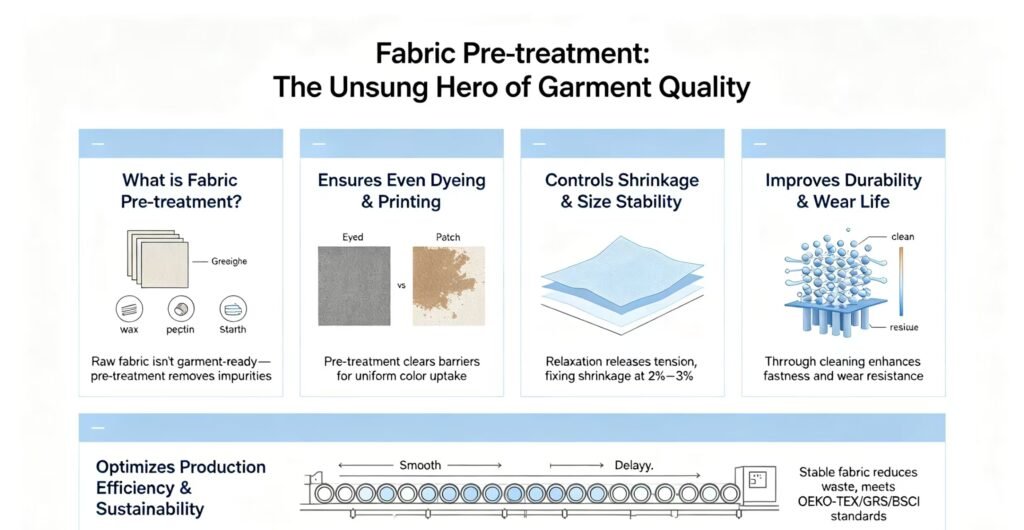
What Exactly Is Fabric Pre-treatment?
Before we dive deep into its importance, let’s start with basic industry knowledge. Fabric pre-treatment refers to a set of mechanical and chemical processes done on raw greige fabric right after weaving or knitting, before dyeing, printing, cutting and sewing.
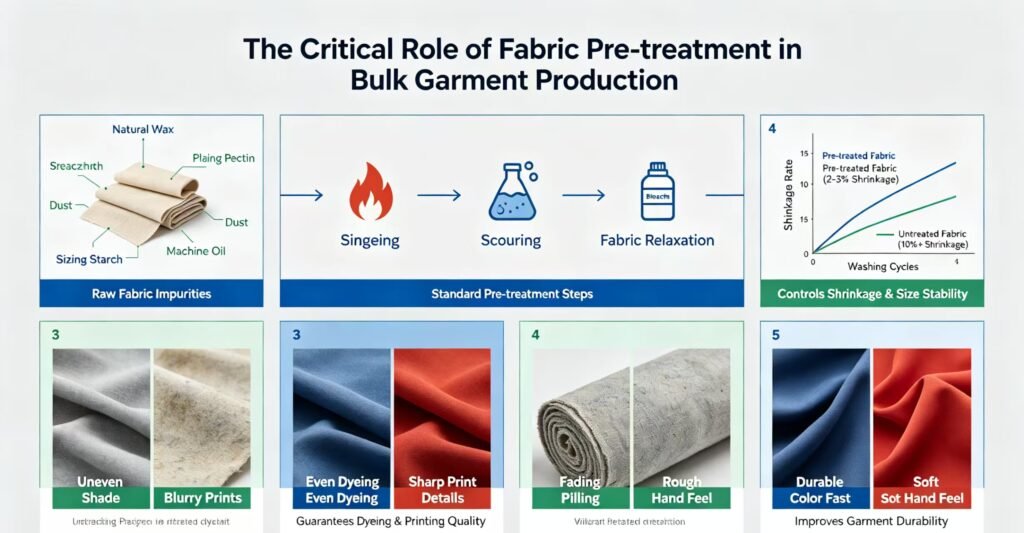
Raw fabric straight from the loom is never ready for direct garment making. It carries natural wax, plant pectin, natural oil from fiber itself, plus sizing starch, machine oil, dust and loose lint left during weaving. All these hidden impurities make fabric stiff, water-repellent, and unable to absorb dye evenly. That’s why fabric pre-treatment becomes mandatory.
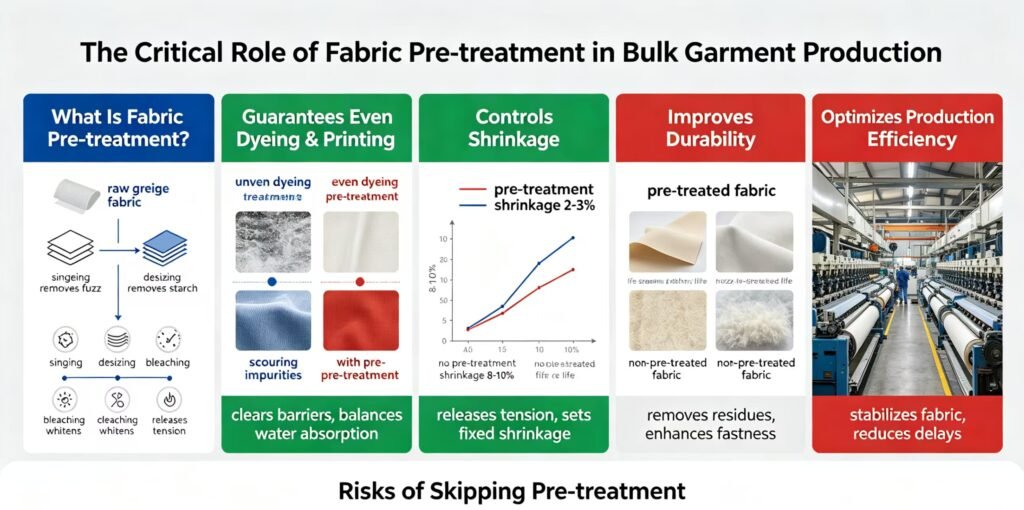
Standard steps of fabric pre-treatment include singeing, desizing, scouring, bleaching and fabric relaxation. Each procedure in fabric pre-treatment aims to clean residue, smooth surface, remove internal tension, and stabilize fabric property. Without complete fabric pre-treatment, all later dyeing, printing and tailoring work will easily go wrong in bulk orders.
Fabric Pre-treatment Guarantees Even Dyeing & Printing Quality
In bulk garment production, uneven shade, patchy color and blurry logo prints are the most frequent quality complaints. Most of these troubles happen simply because factories skip or rush fabric pre-treatment.
Residues and natural wax on raw fabric form a barrier layer, stopping dye liquid from penetrating fiber evenly. When fabric pre-treatment is fully completed, all barriers are cleared, fabric gains balanced water absorption, and every fabric roll keeps the same dye uptake rate.
This means thousands of finished garments can maintain identical tone and shade, no color difference between batches. Meanwhile, singeing inside fabric pre-treatment burns off floating fiber fuzz, making print lines sharper and pattern details clearer. For uniform wear, fashion dresses and custom printed apparel, qualified fabric pre-treatment is the basic guarantee of high-end visual effect.
For manufacturers, standard fabric pre-treatment greatly reduces rework rate. Stable coloring and clear printing pass inspection at one time, saving labor, cutting material waste, and keeping bulk production strictly on schedule.
Fabric Pre-treatment Controls Shrinkage & Keeps Size Stable
Garment shrinkage and deformed sizing are top reasons for customer returns and brand reputation damage. In fact, over 80% of washing shrinkage problems in bulk clothing can be solved simply by proper fabric pre-treatment.
During weaving and knitting, fabric stays under strong mechanical tension. If released naturally in washing or high temperature, fabric will shrink randomly. The relaxation process in fabric pre-treatment lets fabric fully rest and release internal tension in advance, setting fixed shrinkage rate within a safe range.
With professional fabric pre-treatment, shrinkage can be controlled steadily at 2%–3%. Every piece in bulk orders keeps the same dimension after repeated washing, no tightness, no twisting, no out-of-shape issues. Without fabric pre-treatment, different fabric rolls carry different tension, leading to messy sizing and huge after-sales pressure for brands. Investing in standard fabric pre-treatment is always cheaper than dealing with returns and defective inventory.
Fabric Pre-treatment Improves Garment Durability & Wear Life
Consumers always prefer clothes that stay new after long-time wearing and frequent washing. Fading, pilling, rough hand feel and easy tearing are all linked to incomplete fabric pre-treatment.
Natural fiber contains natural grease that weakens fiber structure over time; synthetic fiber leaves machine oil and chemical residue. Thorough cleaning in fabric pre-treatment removes all unwanted substances, tightens fiber combination, improves fabric fastness, and enhances wear resistance.
Besides, qualified fabric pre-treatment helps dye molecules combine firmly with fiber, upgrading color fastness effectively. Clothes do not fade, bleed or stain other fabrics after washing. For work uniforms, daily basics and outdoor apparel with high wearing frequency, reliable fabric pre-treatment directly lifts product grade and user satisfaction.
Fabric Pre-treatment Optimizes Bulk Production Efficiency
Bulk garment production focuses on high output, stable rhythm and low loss. Fabric pre-treatment acts as an invisible booster for the whole production chain.
Untreated fabric is stiff, fuzzy and easy to jam sewing machines; unstable shrinkage causes pattern recutting; uneven dyeing forces production line to stop for adjustment. All these delays raise labor cost and delay delivery time.
After standard fabric pre-treatment, fabric becomes soft, smooth and stable. Cutting is more accurate, sewing runs more fluently, dyeing and printing pass inspection once. Production efficiency rises obviously, and material waste rate drops sharply. For large orders, doing perfect fabric pre-treatment first makes every follow-up process smoother and more profitable.
Fabric Pre-treatment Meets Sustainability & Certification Standards
Now global fashion markets pay high attention to eco-friendly production and safety certification. Fabric pre-treatment plays a key role in helping factories and brands meet international norms.
Complete fabric pre-treatment removes harmful chemical residue, heavy metal substance and unwanted impurities, making fabric qualified for OEKO-TEX, GRS and BSCI audits. Meanwhile, well-processed fabric needs less dye and auxiliary chemicals, saving water and reducing pollution, fitting sustainable fashion trends.
Brands with certified apparel easily enter European and American high-standard markets, and eco-conscious consumers are more willing to buy products with standardized fabric pre-treatment.
Risks of Skipping Fabric Pre-treatment
Cutting corners on fabric pre-treatment may seem to save a little cost at first, but it brings huge hidden troubles:
- Batch color difference and defective printing
- Uncontrolled shrinkage and inconsistent sizing
- Fast fading, pilling and short service life
- Frequent production line delays and order delay
- Higher rework cost, waste loss and after-sales compensation
- Failure to pass international safety certification
All these risks are avoidable as long as brands and manufacturers attach importance to standard fabric pre-treatment.
Final Conclusion
For any bulk garment production project, fabric pre-treatment is never an optional extra step, but a must-do basic procedure. It stabilizes color and print, controls shrinkage, improves durability, lifts production efficiency, and supports sustainable certification.
No matter you are sourcing fabric, cooperating with factories, or managing brand production, always insist on qualified fabric pre-treatment. It is a low upfront investment that brings long-term quality stability, cost saving and brand credibility.